Today, we are exploring a core concept in retirement planning: the difference between chasing high initial yields and focusing on long-term dividend growth. Please note, this information is entirely educational and does not constitute a specific financial recommendation.
The Core Concept: Yield vs. Growth
When planning for retirement, it is tempting to look for the highest possible starting income. However, evaluating the longevity of that income is crucial for enjoying life without reservation.
The High-Yield Approach:
A 12% starting yield looks incredibly attractive on day one because it requires far less initial capital to hit your income goals. However, over a multi-decade retirement journey, high-yield payouts often remain flat or erode over time. When you factor in inflation—with the Consumer Price Index (CPI-U) rising 4.2% annualized as of May 2026—a stagnant income stream rapidly loses its purchasing power.
The Dividend Growth Approach:
Conversely, consider a modest 3.5% starting yield from a portfolio that historically grows its payout by 8% annually. Through the power of compounding, that income stream will double in nine years. This strategy is designed to outpace inflation while simultaneously preserving and growing the underlying investment principal.
The Power of "Dividend Kings" and Tech Snowballs
The dividend growth strategy relies on highly profitable, stable businesses that have a long history of consistently increasing their cash payouts to shareholders. These are often referred to as "Dividend Kings."
Here are a few educational examples from the 2026 landscape:
Johnson & Johnson (JNJ): Recently raised its quarterly payout to $1.34 ($5.36 annualized), marking an impressive 64 consecutive years of dividend increases.
Procter & Gamble (PG): Boasts 136 years of consecutive payouts and 70 straight years of dividend increases, currently at $4.354 annualized.
Coca-Cola (KO) & McDonald's (MCD): Both are reliable dividend growers, paying $0.53 and $1.86 quarterly, respectively.
Microsoft (MSFT): An example of a "tech snowball." While its headline yield is low (around 1.0%), its payout growth is massive—surging from $0.08 per quarter in 2003 to $0.91 in 2026. Long-term holders enjoy a substantial "yield on original cost."
Understanding the Three Income Tiers
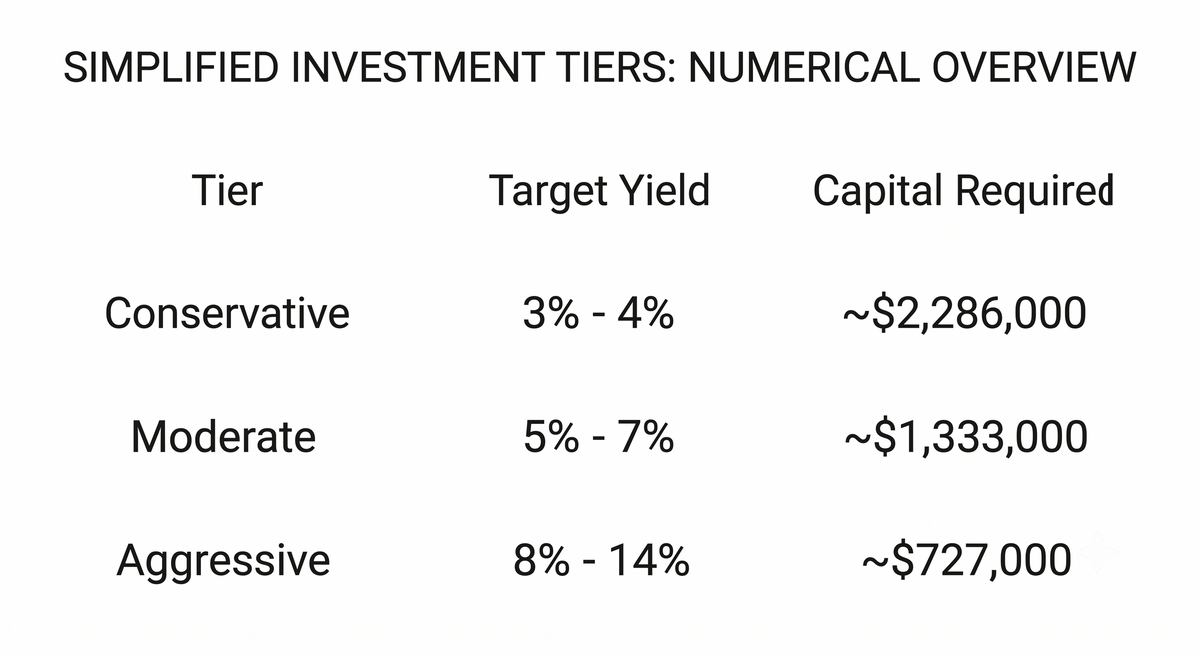
To visualize how these strategies impact your required savings, let's look at the capital required to generate $80,000 in annual retirement income, depending on the risk tier you choose.